
Dental Implants Cary, NC
Dental Implant Dentists in Cary, NC
Learn more about the best dental implants Cary, NC can offer!
Dental implants replace the root of a missing tooth, giving a crown, bridge, or denture a stable foundation that looks and works like your natural teeth. Whether you lost a tooth to an accident, decay, or gum disease, dental implants are a major focus of our practice, and our dentists have years of experience placing them.
Getting an implant involves a minor surgical procedure, so we take time to explain each step, answer your questions, and go over cost and insurance before you commit. Whether you’re missing one tooth or several, or you’re considering dentures and want a more secure option, we’ll help you choose the right treatment. We welcome new patients from Cary, Morrisville, Apex, Raleigh, and across Wake County.
Call 919-363-3100 or request an implant consultation.
What Are Dental Implants?
A dental implant is a small titanium post that replaces the root of a missing tooth. It’s placed in your jawbone, and over the following months it fuses with the bone to form a strong, stable anchor. A connector called an abutment is then attached, and a custom-made restoration is secured on top.
Because an implant sits in the bone the way a natural root does, it gives your replacement teeth a foundation that doesn’t depend on the teeth around it. Dental implants can support:
- A single crown
- A dental bridge
- Full or partial dentures
Who Needs Dental Implants?
Implants may be a good option if:
- You’ve lost a tooth to an accident, decay, or gum disease, and you want a replacement that looks and works like a natural tooth.
- A tooth can’t be saved. If the root is infected or the tooth is too damaged to repair, removing it and placing an implant can restore the space.
- You’re considering dentures or a bridge. Implants can anchor dentures so they don’t slip, and an implant-supported bridge doesn’t require reshaping your healthy neighboring teeth.
If you’ve recently lost a tooth, it’s worth booking a consultation soon. Replacing it sooner helps protect the surrounding teeth and jawbone. After an exam and x-rays, we’ll tell you whether implants are a good fit for you, and what your options are if they aren’t.
Benefits of Dental Implants
Implants offer advantages that other tooth replacement options can’t fully match:
- Natural appearance. Your new tooth is shaped and shaded to blend in with your smile.
- Clearer speech and easier chewing. Dentures without implants can shift in your mouth, which may cause mumbling or slurred speech. Implants stay put, so you can talk and eat with confidence. Learn how implants improve chewing, speaking, and comfort.
- Strength and durability. Once healed, an implant becomes part of your jaw. With good care, the implant itself can last for decades, though the crown on top may eventually need replacing.
- Better oral health. An unreplaced gap raises your risk of further problems, like gum disease and shifting teeth. An implant fills the space without altering your healthy neighboring teeth.
Why Replace a Missing Tooth?
Losing a baby tooth is a childhood milestone. Losing an adult tooth is not. A gap at the back of your mouth may go unnoticed, so it’s tempting to put off replacing it, but a missing tooth causes problems whether or not it shows:
- Your other teeth take on extra work. When one tooth is missing, the others compensate, which can lead to jaw pain, premature wear, and temporomandibular joint (TMJ) problems.
- Nearby teeth can shift. Neighboring teeth may tilt or drift into the gap, changing your bite and making those teeth harder to clean.
- Your jawbone weakens. Tooth roots stimulate the bone around them. Without a root, the bone gradually shrinks, which can eventually put nearby teeth at risk and change the shape of your face.
- Eating gets harder. Depending on which tooth is missing, some healthy foods become difficult to chew.
Dentures vs. Bridges vs. Dental Implants
We offer several ways to replace missing teeth. Here’s how they compare:
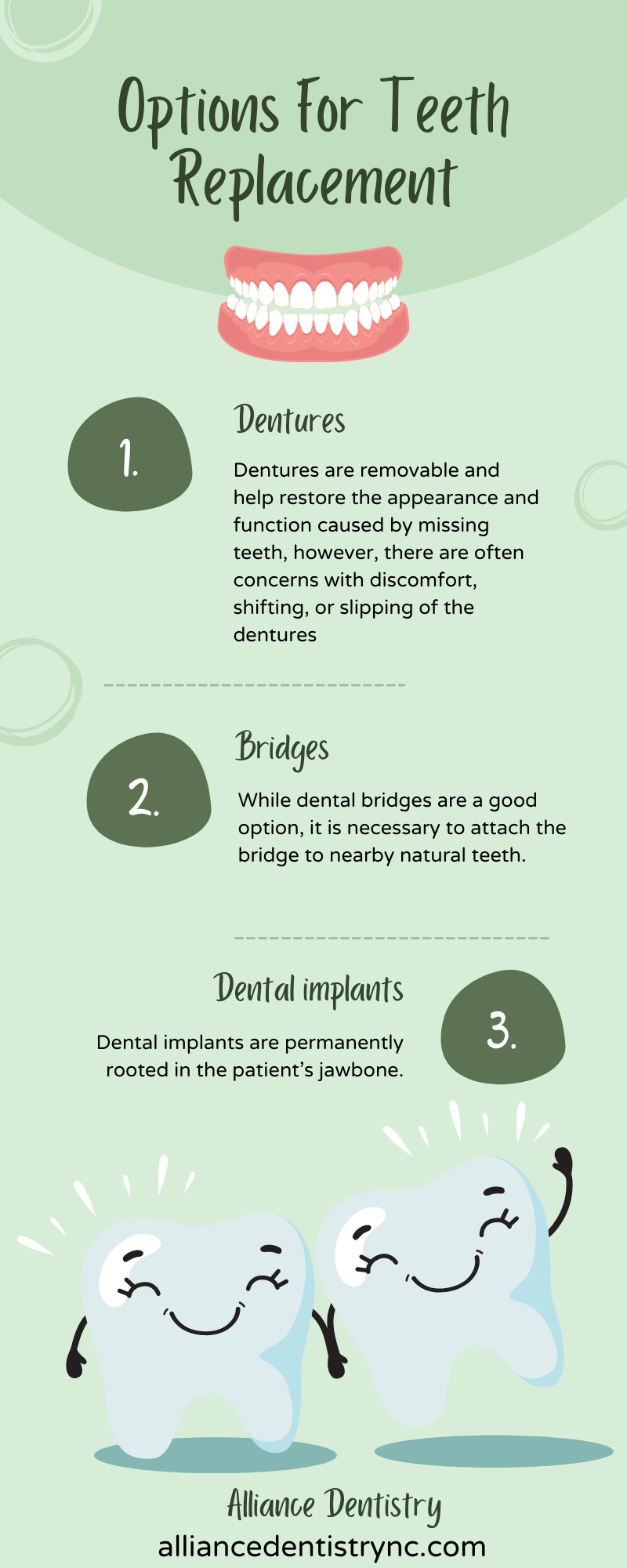
- Dentures are removable and rest on the gums. They restore your appearance and much of your chewing ability, but some patients find they shift, slip, or feel uncomfortable, and they can affect speech. Dentures usually need relining every few years as your mouth changes.
- Bridges are a fixed option, but they rely on the neighboring teeth, which must be reshaped to hold the crowns that anchor the bridge. Bridges often need replacing after 5 to 15 years.
- Dental implants are anchored in your jawbone, so they don’t slip and don’t require altering your healthy teeth. With good care, the implant itself can last for decades.
Because an implant replaces the tooth root, it’s the only one of these options that helps keep your jawbone healthy. Dentures rest on the gums and bridges depend on neighboring teeth, so neither stimulates the bone. The best choice depends on your teeth, gums, and bone, and we’ll go over all of your options at your consultation.
If a Tooth Is Knocked Out or Loose
Knocked-Out Tooth
A knocked-out adult tooth is a dental emergency. Whether it can be saved depends mainly on how you handle it and how quickly you get to a dentist. Call us right away at 919-363-3100 and follow these steps:
- Hold the tooth by the crown only. Never touch the root. It carries fibers the tooth needs to reattach, and handling it can damage them.
- Rinse gently if it’s dirty. Use milk or tap water for a few seconds. Don’t scrub, dry, or wrap the tooth in a cloth or tissue.
- Keep it moist. If you can, gently place it back in the socket and bite down on a clean cloth. If not, store it in milk, saline, or the patient’s saliva until you reach our office.
- Get to a dentist fast. The sooner the tooth is back in place, the better its chances, so aim for within an hour.
Don’t put a knocked-out baby tooth back in the socket, since that can damage the adult tooth developing underneath. Just call us.
If an adult tooth can’t be saved, we can talk about replacing it with a dental implant once the area has healed.
Loose Tooth
If an injury loosens a tooth but it’s still in the socket, see a dentist promptly. We may gently move it back into position and stabilize it with a splint, a thin material bonded across the loose tooth and its neighbors, while it reattaches. Without treatment, a loose tooth may fall out.
Dental Implant Treatment Options
Every patient’s mouth is different, so your dentist will build a treatment plan around your oral health, your goals, and the condition of your jawbone.
Replacing One Tooth
A single implant topped with a custom crown replaces one missing tooth without affecting the teeth on either side.
Replacing Several Teeth
If you’re missing two or more teeth, you usually don’t need one implant for every tooth. In many cases, two implants can support a bridge that replaces several teeth in a row.
Replacing a Full Arch
If you’ve lost all of the teeth in your upper or lower jaw, a full set of replacement teeth can be anchored to a small number of strategically placed implants. That gives you a stable, secure alternative to traditional removable dentures. Implants are also a great option for older adults. Learn why dental implants work well for seniors.
When You Need More Bone: Grafting Procedures
A successful implant needs enough healthy jawbone to hold it. If you’ve lost bone because a tooth has been missing for a while, or from gum disease or injury, a bone graft can rebuild it.
- Sinus augmentation (sinus lift). The upper back jaw sometimes doesn’t have enough bone below the sinus. A sinus lift adds bone in that area so the implant has a solid base.
- Ridge modification. If the jawbone has worn down or has an uneven shape, the gum is gently lifted and the area is filled with bone or a bone substitute to rebuild the ridge.
Grafting adds time to treatment, but it makes implants possible for many patients who might otherwise be told they aren’t candidates. We’ll check your bone with x-rays and an exam, so you’ll know before treatment begins whether you need a graft.
What to Expect: The Dental Implant Process
Implant treatment happens in stages over several months. Here’s what a typical process looks like:
- Consultation and planning. We examine your teeth, gums, and jawbone, take x-rays, and explain your options, timeline, and costs.
- Bone grafting, if needed. If you need a graft, it’s usually done first and given time to heal before the implant is placed.
- Implant placement. The implant post is placed in your jawbone in a minor surgical procedure using local anesthesia. Most patients have mild soreness for a few days, which over-the-counter pain relievers usually control.
- Healing. Over the next few months, the implant fuses with your jawbone. A temporary tooth can often be worn during this time so you’re never without a smile.
- Your new tooth. Once the implant has healed, we attach the abutment and your custom crown, bridge, or denture.
For more detail, read about the process for getting dental implants.
Types of Dental Implants
- Endosteal implants are by far the most common type. A small, screw-shaped titanium post is placed directly in the jawbone, where it acts as an artificial tooth root.
- Subperiosteal implants use a metal framework that rests on top of the jawbone, under the gum. They’re rarely used today, since bone grafting now allows most patients to receive endosteal implants instead.
Your dentist will recommend the approach that fits your bone, your health, and your goals.

Getting the Most Out of Your Implant Consultation
The best results come from understanding your options before you commit to a plan. Bring your questions, and don’t be shy about asking. Questions worth asking include:
- Am I a good candidate, and will I need a bone graft or sinus lift first?
- What type of implant and restoration do you recommend for me, and why?
- What will the full treatment cost, and how much will my insurance cover?
- How long will treatment take from start to finish?
- How should I care for my implant afterward?
Why Choose Alliance Dentistry for Dental Implants in Cary
With dental implants, the planning matters as much as the procedure. At our Cary office, the same team examines your bone and gums, places your implant, and plans the dental crown, bridge, or denture that goes on top of it. Keeping your care under one roof means fewer referrals, a clear timeline, and one team that knows your history from your first visit to your final restoration.
We’ll walk you through every option, including when a bridge or denture may make more sense than an implant, so you can make the choice that fits your health, goals, and budget. Patients come to our Cary office on Davis Grove Circle from across Wake County, including Morrisville and Apex.
What Affects the Cost of Dental Implants in Cary?
Every implant plan is different, so the cost depends on what your treatment involves. The main factors include:
- Number of implants: Replacing one tooth costs less than replacing several teeth or a full arch.
- Type of restoration: A single crown, an implant bridge, and an implant-supported denture each have different costs.
- Bone grafting or extractions: If you need a tooth removed or more bone before placement, those steps add to the total.
- Imaging and planning: X-rays and scans help us place your implant safely and accurately.
- Insurance coverage: Some plans cover part of the crown or other parts of treatment, even if they don’t cover the implant itself.
We’ll give you a written estimate and review your insurance benefits before treatment begins, so there are no surprises. Over time, implants are often a cost-effective choice because they’re designed to last for many years with good care.
Dental Implant FAQs
Am I a candidate for dental implants?
Most adults who are missing teeth and have healthy gums are good candidates. You need enough jawbone to support the implant, though bone grafting can often rebuild it. Smoking and uncontrolled diabetes can slow healing and raise the risk of implant failure, so we’ll review your health history carefully. Learn more about diabetes and dental implants. For younger patients, implants are placed once the jaw has finished growing, usually in the late teens.
Does getting an implant hurt?
Implant placement is done with local anesthesia, so you shouldn’t feel pain during the procedure. Afterward, most patients have mild soreness and swelling for a few days, which over-the-counter pain relievers and cold compresses usually control.
How long do dental implants last?
With good care, the implant post can last for decades, and often a lifetime. The crown on top may eventually need replacing due to normal wear.
How do I care for my implant?
Brush twice a day, clean between your teeth daily, and keep up with regular checkups and cleanings. Implants can’t get cavities, but the gums and bone around them can become infected if plaque builds up.
Does insurance cover dental implants?
Coverage varies by plan. Many plans cover part of the cost, especially the crown or restoration on top of the implant. We’ll check your benefits and review the full cost with you before treatment begins. See our insurance information.
Dental Implant Glossary
Implant (implant post). The small titanium post placed in your jawbone to act as an artificial tooth root.
Osseointegration. The process of the jawbone growing around and bonding to the implant post, creating a stable foundation. It typically takes a few months.
Abutment. The connector that attaches to the implant post and holds your replacement tooth in place.
Crown. The custom-made, tooth-shaped cap that attaches to the abutment and replaces the visible part of a missing tooth.
Implant-supported bridge or denture. A bridge or set of replacement teeth held in place by implants instead of resting on the gums or relying on neighboring teeth.
Bone graft. A procedure that adds bone or a bone substitute to the jaw when there isn’t enough bone to support an implant.
Peri-implantitis. An infection and inflammation of the gum and bone around an implant, similar to gum disease. Good daily cleaning and regular checkups are the best prevention.
What Our Patients Say
“Moved down here from the Chicago area and sought out a dentist and I can’t be more happier with this office. All the people are professional. The dentists are like your best friends and they sit and talk with you for as long as it takes and listen to all your questions and want to make the experience a positive one. You can’t go wrong with this office. Fantastic dental office.”
— Doug S.
Schedule Your Dental Implant Consultation in Cary
If you’re missing one tooth or several, the first step is a consultation. We’ll examine your teeth, gums, and jawbone, explain your options, and review costs and insurance before you decide anything. Call Alliance Dentistry at 919-363-3100 or request an appointment today.
Alliance Dentistry
202 Davis Grove Circle, Suite 102
Cary, NC 27519